Four Steps for Better Side Decking in Goat Format
This article outlines a four-step process for improving side decking strategies in Goat Format, emphasizing matchup-specific considerations and card adaptability.


One of the most common questions I see in the Goat Community is "how do I side deck as x deck for y matchup"? More often than not, the answer people will get in response is "it depends", and that isn't because people don't want to help others learn how to side - it's because this is probably one of the most open-ended questions you can ask a Yu-Gi-Oh! player and depends on a variety of factors. These factors include things like how common a bad matchup is, how many cards you can afford to side in/out without making the overall strategy fall apart, and what you expect your local metagame to be.
For example, if you're playing a deck that is relatively non-linear and has a lot of interchangeable parts, such as Goat Control, you can choose to side a lot for a specific matchup if you deem it necessary to do so. I personally side 12 cards as Goat Control against most aggro decks, and while a lot of people would deem that as being overkill, the reality of the matter is that a) the matchup is generally so unfavorable to the point where I feel this is justified; b) in my local metagame, it is common enough to warrant being this prepared for it; and c) I can afford to do so without rendering my deck choppy and unplayable. On the flip side, if you're playing a deck that is relatively linear and has few interchangeable parts, such as Flip Control, you have less slots to work with in terms of what you can take out. With Flip Control, you can't take out too many Flips (otherwise you won't be able to reliably generate advantage and recur your resources), you can't take out too many power Spells, and you certainly can't take out most of the Traps allowing you to Tsukuyomi lock your opponent alongside another Flip Effect monster. For this reason, you might not be able to side as much for a matchup as you would otherwise want to, so you will have to make a compromise somewhere and either settle for high-impact cards that are relatively narrow or lower-impact cards that are better against a wider variety of decks. Another very important thing to note is that a card that is good in one Side Deck is not necessarily good in all of them. For example, just because Royal Decree is good against Burn doesn't mean I should be siding it as an Anti-Meta Warrior player: doing so would shut off my own Traps, and I need those for my deck to function properly. Thus, in this particular scenario, one would need to consider alternative cards that are equally as effective, such as Xing Zhen Hu or Mobius the Frost Monarch. There is no way I can write a "Side Decking for Goat Format" article that would do the topic justice, so I've decided to limit the scope of this article to a simple four-step process that can be used to improve anyone's Side Decking game.
Siding Out
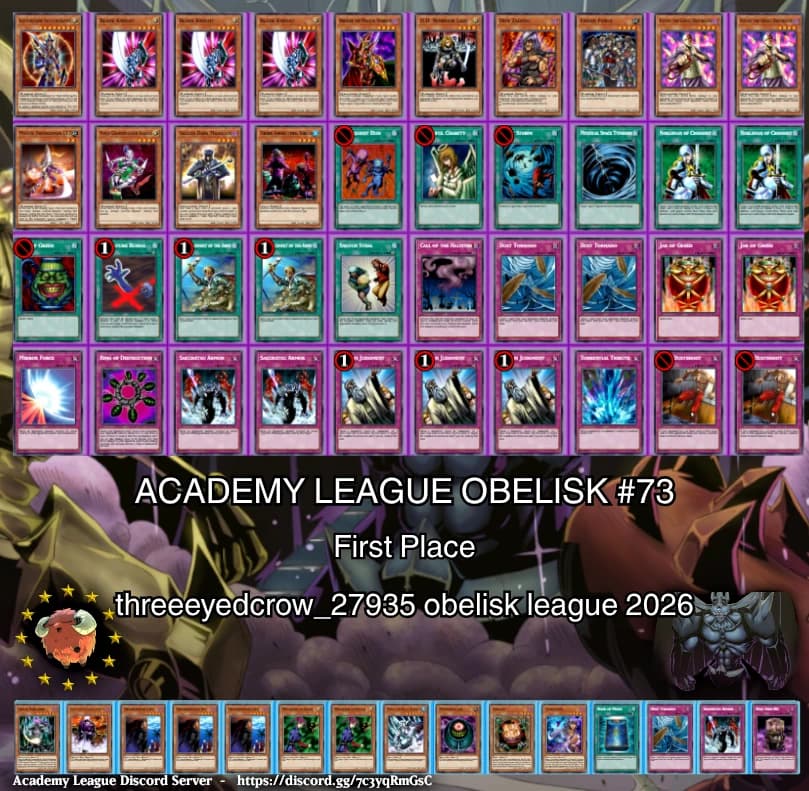
Start off with making a list of all the cards that could potentially come out of your Main Deck in any given matchup during Games 2 and 3. Obviously, not all of these cards will come out for every matchup, but making this list gives you a clear understanding of what is necessary for your deck to function and what isn't. For example, in Frank's 3rd place Goat Control deck, this list would include, but not be limited to:
- Airknight Parshath
- Black Luster Soldier - Envoy of the Beginning
- Morphing Jar
- Tribe-Infecting Virus
- Tsukuyomi
- Book of Moon
- Delinquent Duo
- Heavy Storm
- Mystical Space Typhoon
- Nobleman of Crossout
- Premature Burial
- Scapegoat
- Snatch Steal
- Call of the Haunted
- Dust Tornado
- Mirror Force
- Sakuretsu Armor
Does this list surprise you? For each of these cards, I can name at least one matchup in which it should be sided out. If I've piqued your interest or you don't believe me, feel free to ask me in the comment section about this claim.
What Are You So Scared Of?
Make a list of the matchups you're worried about/your hardest matchups and how common they are in your expected metagame. For example, if you're playing a Goat Control deck at your local and you are deathly afraid of the Anti-Meta Warrior matchup, but you know for a fact absolutely nobody at your local plays Warriors (or any aggro deck for that matter), you probably shouldn't side for it, right? On the other hand, an extremely common matchup may merit some Side Decking even if you believe it's a strong one for your Main Deck to begin with. For starters, a hypothetical local metagame in 2019 will probably include the following decks:
- Goat Control
- Anti-meta Warrior
- Thunder Dragon Chaos
- Reasoning/Gate
What Are You Going to Do About It?
Come up with a list of cards that would be good against each matchup you are worried about. Once you’ve done so, cross out the cards that would either be anti-synergistic with your Main Deck AND/OR are too low-impact or versatile to be worth siding. Let's try this for Thunder Dragon Chaos, one of the four decks we listed above:
- Kycoo the Ghost Destroyer
- Blade Knight
- Mystic Swordsman LV2
- Creature Swap
- Mind Control
- Trap Dustshoot
But wait! We're not done yet. What if we're playing Anti-Meta Warriors, with three copies each of Kycoo the Ghost Destroyer, Blade Knight and Trap Dustshoot already packed into the Main Deck? We're going to have to cross those out and look harder, perhaps with an eye to cards more specific to our own strategy. On this second pass, we'll also exclude Creature Swap for anti-synergy with our own deck, since Anti-Meta Warriors typically don't have a lot of useful monsters of their own to use it with:
- Zombyra the Dark
- Mystic Swordsman LV2
- Mind Control
- Deck Devastation Virus
Putting It All Together
Once you've narrowed this list down, open a word processor or Google doc. Compile a list/chart of matchups and what comes in and out for that matchup based on the information from the first three steps above. If your Side Decking depends in part on whether or not you go first or second, be sure to make note of that. Writing this information down for your own reference and keeping it in a digital file will allow you to side faster IRL, help you stay relaxed as you side online, and ultimately ensure you are prepared for what you expect to play against. From our sample information above, let's put together an example of what this might look like for Goat Control against Thunder Dragon Chaos: In: Blade Knight (1), Mystic Swordsman LV2 (1), Creature Swap (2), Trap Dustshoot (2) Out: Airknight Parshath (1), Tsukuyomi (1), Sakuretsu Armor (2), Dust Tornado (2) If you follow these four simple steps, you will be much more competent with side decking than the average Goat player.
Morpp
Morpp is the man behind the Online Goat Format Community (OGFC) Facebook page. Despite only getting started with Goat Format in April 2018, his Yu-Gi-Oh! resume is pretty solid; he placed 3rd in GoatFormat.com’s $100 Freeroll Tournament with Team Monsanto’s patented Stun Aggro variant of Anti-Meta Warriors and has topped numerous local and regional-level events in Ontario, Canada. He also streams regularly. You can find him on Twitch at: https://twitch.tv/Morpp_YGO.