Community Profile: Team Evolution
This article profiles Team Evolution, a new competitive Yu-Gi-Oh! team formed from members of Team Cobra and Team Obvolution, emphasizing friendship, mutual support, and respectful play.

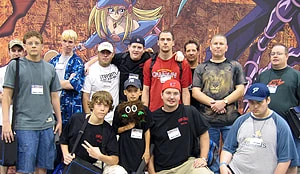
Do you ever wonder what happens when a group of players realize they’re spread across two different teams? Well, in this instance, a new team was formed. Taking some members from Team Cobra and some from Team Obvolution, Team Evolution aims to live up to its name by taking the concept of growth from experience and running with it. It’s a fairly substantial group, and nine or ten players are here from Regionals qualifications. The last unqualified member, Bobby Clark, made it to the final round of the last-chance qualifier, but didn’t make the Top 8. He stuck around the event in a support role, which was greatly appreciated by the other members of the team.
Jordan Savage, longtime member of Team Cobra, acted as Team Evolution’s spokesman. I’ve known Jordan for a while, since he’s usually at the events I judge. “This is basically how it happened,” he explained. “A bunch of us across the different teams were really good friends, so we decided to come together and do something new. We pretty much told everyone in both teams that whoever wanted to come over could do so, we got Zack Johnson, we got Bobby Ashworth . . . Zak Bishop from Cobra. Nick Curtis went into the military, so we don’t have him anymore. We’re trying to build a team of good players who aren’t, you know, making a scene in a negative kind of way. We want to have a good name, and so we chose “Evolution” because we want to keep it constantly changing and improving.”That’s been a common idea that has cropped up in a lot of conversations I’ve had with teams. The idea of respect as something that is earned by one’s actions, rather than the force of one’s trash talk, seems to be part of the glue that draws some groups together. This is the first time I’ve seen two previously established teams shift to generate a third, and the idea was interesting. “It really all came about out of the friendships that were there,” Jordan explained. “We share cards, sell cards and so forth to help each other out anyways, so we might as well all be on one team. This morning, I forgot my deck at Chris’ house. I was up until 5 AM testing and all that, and then I went and left it on the table. I got here ten minutes before registration closed, so I had to borrow my uncle’s deck. If I’d come here on my own, I’d have been screwed. At least this way I had a backup—I helped build the deck so I’m familiar with it, anyway.”The team had decent standings going into the event, but the focus seemed to be not so much “take the team all the way” but rather “enjoy the event and the people who are here.” “I’m a sore loser,” Jordan admitted, “but today I’ve been able to enjoy the event and respect the other people I played. I lost my last match, but I was able to shake my opponent’s hand and say ‘Good game!’ and mean it. I was okay about it, and I could give him the respect he earned. That’s the kind of thing we want to do with our new team.”Hybrids are nothing new in the game as far as decks are concerned, but seeing teams branch off and reform as new entities is rather novel. Organized play has increased dramatically this season, adding in Shonen Jump events and ramping up the total number of Regionals. Players who previously saw one another only rarely are now afforded the opportunity to mingle more often, potentially resulting in more hybrid teams. As more and more players get exposure and recognition, team networking speeds up. What might we see at next year’s Nationals? Possibly the same groups we have now and maybe some new combinations. It has seemed to work fine for Evolution—perhaps the pattern will spread?
Metagame.com (2005)
This article was originally written by Metagame.com, what was formerly the official website for large Yu-Gi-Oh! tournament coverage. It has been preserved by GoatFormat.com so that players can learn from this historical tournament coverage.